Operational floor
68 controllers per rating. Attrition may temporarily reduce a rating below this level.
36-Month Manpower, Training & Experience Distribution Analysis · M0–M36
Operations-first projection across AP, AS and APS integrating OJT progression, College movement, attrition and operational experience.
68 controllers per rating. Attrition may temporarily reduce a rating below this level.
80 operational controllers for each rating.
AP → AS → APS. Operational/OJT progression takes precedence over College scheduling.
MAVA up to 40 new staff annually; projection uses 20 KLATCC controllers per annual intake.
15 current-method + 5 Two-Stream.
3 controllers every 12 months, deducted from APS for projection purposes.
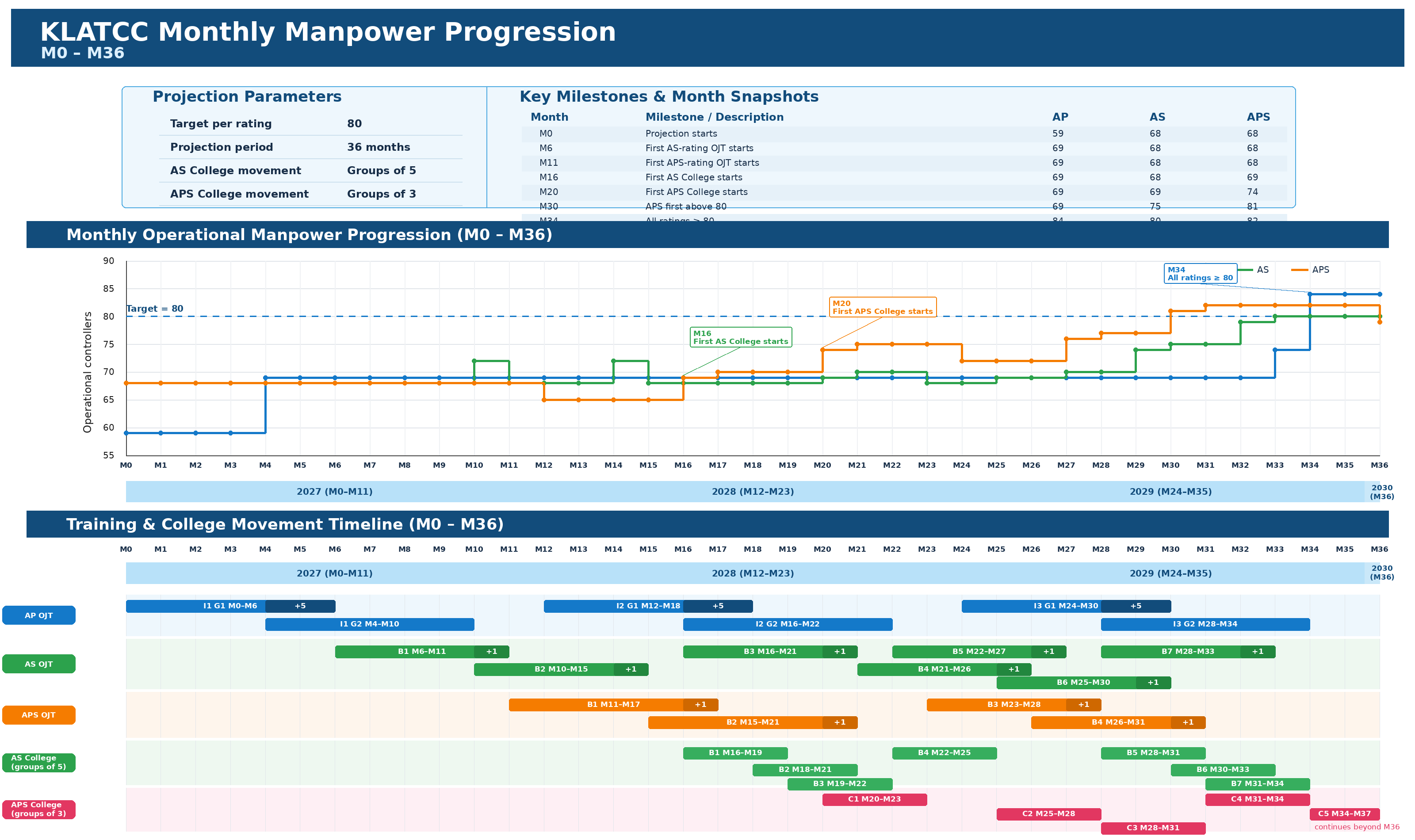
AP-rated month → AS College start. Range 12–14 months; average ≈13 months.
Five groups × 3 controllers. C5 extends beyond M36.
The experience distribution uses the same month-by-month data as the approved infographic and is an experience-duration view, not an operational qualification status.
An OJTI requires at least 24 months (2 years) of working experience as a qualified controller and at least 6 months on the relevant rating or validation, together with the other applicable requirements.
CAD 1201 also permits OJT under a rated controller who is not an OJTI while the assigned OJTI remains responsible for the training objectives. The relevant note states no specific minimum number of months of experience for that rated controller.
The current-rating experience period starts in the month the controller obtains that rating. A controller is counted as having 6 months or more of experience from the sixth month after obtaining the rating.
The projection shows a progressive build-up of AP, AS and APS while OJT and College movement continue. The first common month in which all three ratings are at or above the target of 80 is M34, at AP 84 · AS 83 · APS 82.
Extend the analysis to determine the level of operational buffer required above the target of 80, taking into account attrition, OJT and College movement. This will help establish a sustainable manpower level rather than assuming a fixed buffer in advance.
Extend the model to M48 and M60 to test the manpower position after the initial 36-month build-up and identify the longer-term effect of attrition.
Use the extended projection to determine the minimum sustainable annual intake required to maintain AP, AS and APS while allowing OJT and College progression to continue.